What mapping Estonia's healthcare system taught me about designing for people who fall between the gaps
Estonia is one of the most digital countries in the world. Prescriptions are digital, medical records are online, and most public services work through a single portal. On paper, it should be one of the easiest places to access healthcare.
So why did 68% of the international students we surveyed not have a family doctor?
In the autumn of 2025, as part of my Master's in Artificial Intelligence for Sustainable Societies at Tallinn University, I worked with three classmates on a project for the Estonian Ministry of Culture, which leads the country's adaptation and integration programme for newcomers. Our question sounded simple: how do international students actually access healthcare in Estonia, and where does it break down?
The answer turned out to be less about medicine and more about paperwork, language, and systems that were never designed with newcomers in mind.
The gap between entitlement and access
Every international student in Estonia must have health insurance. EU students are covered through the European Health Insurance Card. Non-EU students must buy private insurance to get their visa or residence permit.
In theory, everyone is covered. In practice, being insured and being able to see a doctor are two very different things.
We combined several sources to understand this gap:
A survey of around 20 international students with different nationalities, lengths of stay, and insurance situations
Four in-depth interviews, each of us talking with one international student about their healthcare journey
An expert interview with the Tallinn Migration Centre, which supports migrants in navigating public services
Public events on newcomer services, including a co-creation session run by the Integration Foundation
Desk research into insurance rules, residence permits, and digital health services
What we found was consistent across all of them.
What students told us
Language was the most common barrier. More than half of the students surveyed (53%) had experienced language barriers during medical visits. Family doctors in Estonia are not required to speak English, and English-speaking staff are unevenly spread across clinics and regions.
Most students didn't have a family doctor. In Estonia, the family doctor is the gateway to almost everything: referrals, specialists, ongoing care. Yet 68% of our respondents didn't have one. Some hadn't needed one yet, but many said it was hard to find a doctor at all, or one who speaks English. One student wrote that, after 18 months of living in Estonia, it was still frustrating not to have a family doctor. Another simply asked: should I even get one, and how?
Students trust friends and search engines more than official channels. When students had questions about healthcare, they turned to the internet (79%) and friends (74%). Almost half (47%) used AI tools. Only 37% asked their university, 21% asked government agencies, and just 11% contacted their insurance company.
That last finding stayed with me. It isn't that official information doesn't exist. It's scattered across government portals, university websites, and insurer pages, and it's often hard to understand, even for locals.
The Tallinn Migration Centre's own research supported this at a much larger scale. In their survey of 560 migrants, more than 60% said accessing healthcare information was a problem, and half reported difficulty accessing healthcare services in general.
When care works, it can work very well. Not every story was negative. One student described a serious emergency that ended in fast, professional surgery at a very low cost, with an English-speaking nurse explaining every step. The problem was rarely the quality of care. It was getting into the system in the first place.
Mapping the system, not just the journey
My main responsibility in the project was leading the Actor-Network Theory (ANT) analysis and creating the diagrams that mapped how healthcare access actually works.
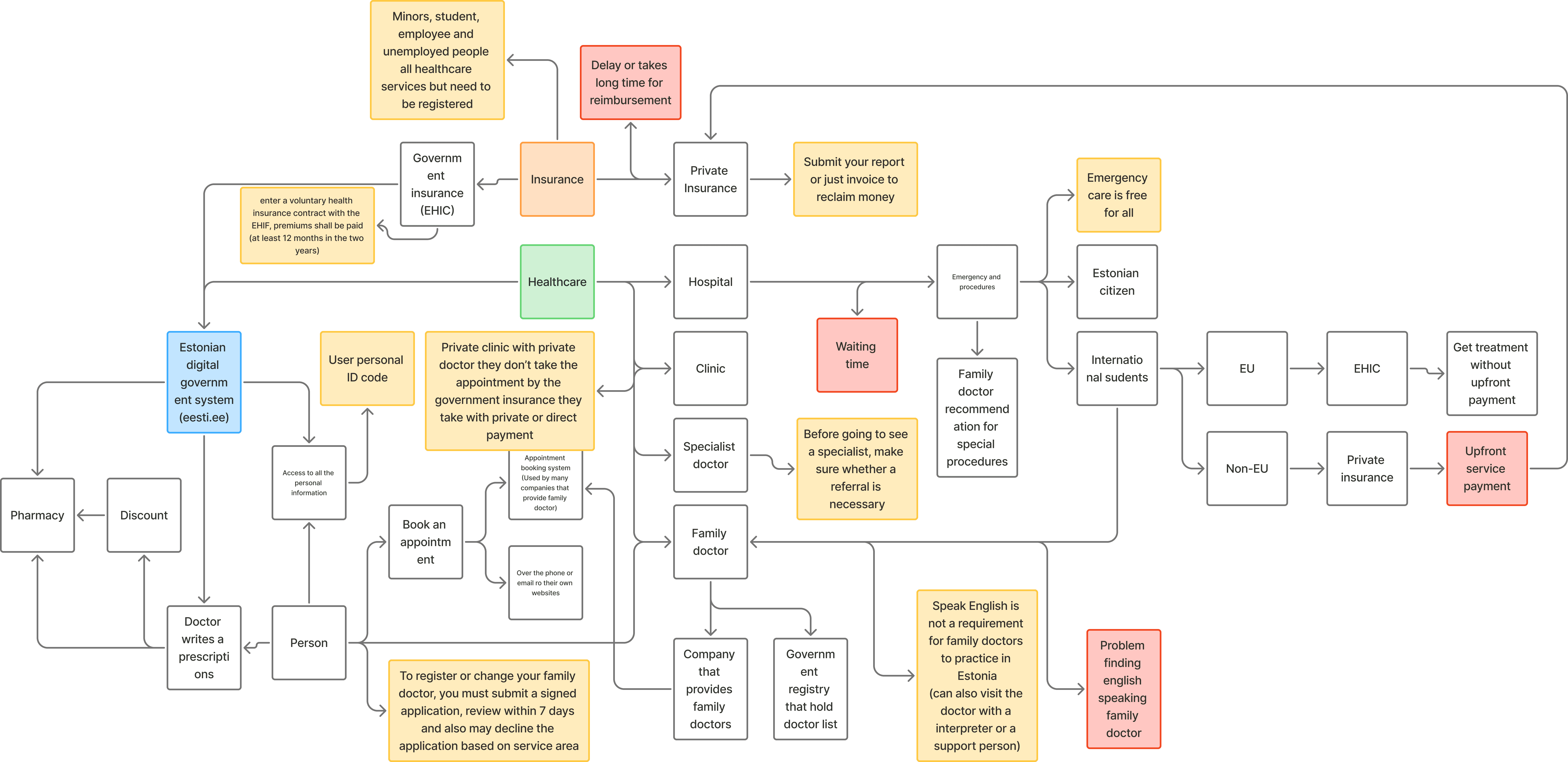
At first, we tried to map the problem as a simple user journey: a student gets sick, finds a doctor, gets treated. It didn't work. A linear journey hid the real problem, which was all the institutions, rules, and documents a student depends on before that journey can even start.
ANT gave us a different lens. It treats non-human things as actors too: a residence permit, a language policy, an insurance rule, a website. Each one can open or block a path to care. When we mapped these actors and their connections, the breakdowns became visible.
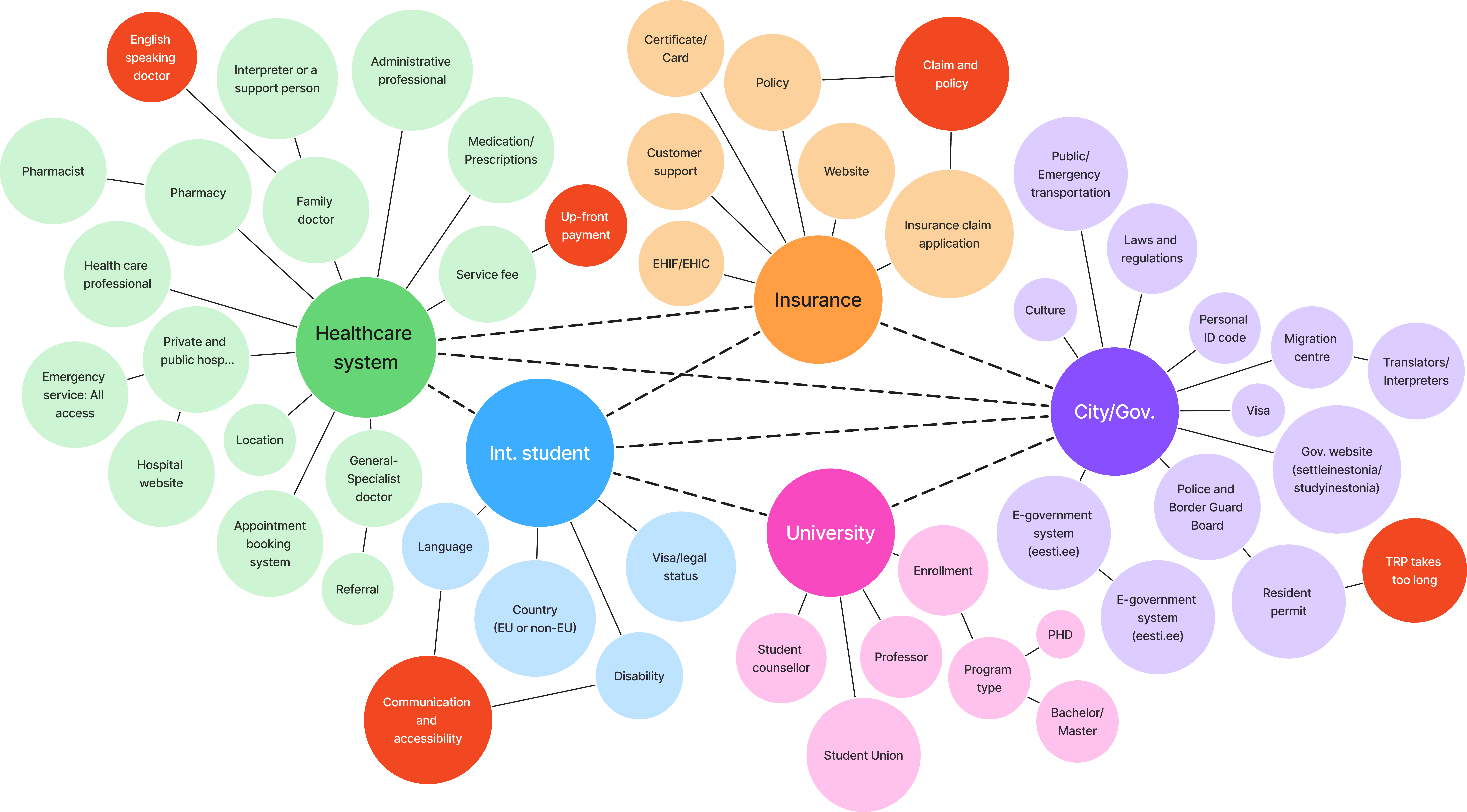
Three findings stood out.
1. A document can decide whether you see a doctor
Registering with a family doctor often depends on having a Temporary Residence Permit, and getting one can take months. During that time, students are pushed toward emergency services, which aren't meant for non-urgent care, or toward private clinics, which cost more. A delay in one office quietly blocks access to the whole public healthcare system.
2. The same system splits into two different experiences
For EU students, the European Health Insurance Card usually means treatment without paying upfront. For non-EU students relying on private insurance, the experience is often very different: pay first, then go through claims and reimbursement. Two students in the same classroom can face completely different financial barriers to the same doctor.
3. Language doesn't just carry information. It changes the system
Because English isn't required for family doctors, a clinic that works perfectly for Estonian speakers can become a closed door for everyone else. Students then build workarounds: bringing a friend to translate, using translation apps, or leaving the public system for a private clinic. Free interpretation services do exist, but many students and even healthcare providers don't know about them.
The pattern behind all three was the same. Instead of being supported by the system, international students become the ones holding it together, filling every gap with their own time, money, and social networks.
When values pull in different directions
We also used Value Sensitive Design, a method for making the human values inside a system explicit. We identified the values that mattered to each stakeholder, such as accessibility, clarity, fairness, privacy, timeliness, autonomy, trust, and dignity, and mapped where they conflicted.
Some of these conflicts have no easy answer:
Privacy vs. timeliness. Strong data protection keeps medical information safe, but it also makes it harder for universities, clinics, and authorities to share information that would speed up access.
Procedure vs. accessibility. Strict legal processes make the system fair and compliant, but they delay care for students still waiting on documents.
Workforce realities vs. comprehension. Not requiring English protects doctors who are already overloaded, but leaves many international students unable to understand their own care.
Seeing these tensions clearly changed how we thought about solutions. A good solution can't just optimise one value. It has to be honest about what it trades off.
From "build an app" to changing the system
Our first instinct was to design a digital tool. We sketched a Healthcare Navigator, a low-fidelity prototype that would guide students step by step: what to do when you feel ill, when to choose emergency care, a family doctor, or a private clinic, how to find English-speaking services, and how payments and reimbursement work.
Then our professor challenged us: were we only solving the tip of the iceberg?
He was right. An app can help people navigate a confusing system, but it can't fix why the system is confusing. So we reframed our output as a roadmap across three time horizons.
Short term: reduce immediate friction
Standardised, plain-English healthcare information from clinics, including how to register, book, and whether English is available
Interpretation treated as a normal safety net, not a rare exception
Healthcare information that meets digital accessibility standards like WCAG
Using universities, student organisations, and buddy programmes as trusted information channels
Medium term: remove structural bottlenecks
Issuing Temporary Residence Permits instead of long-term D-visas to international students, so they can register with a family doctor sooner. This would align Estonia with countries such as Finland, Germany, and the Netherlands.
Long term: a Student Health Gateway
A single, student-specific entry point to healthcare, connected to universities and the national system, inspired by models such as the Finnish Student Health Service (YTHS). It would enrol students automatically based on their student status and offer digital-first consultations.
What this taught me as a designer
I've spent six years designing digital products, and this project changed how I think about my work in three ways.
The interface is rarely the whole problem. Many of the barriers we found could not be fixed with better screens. A beautiful booking flow doesn't help if you can't register with a doctor until your permit arrives. Sometimes the most important design decision is a policy, a process, or a partnership.
Accessibility is more than WCAG. I've always cared about digital accessibility, but this project made the idea much broader for me. Accessibility includes language, legal status, cost, physical buildings, and whether information exists where people actually look for it. A perfectly compliant website still excludes people if they never find it.
AI can help, and it can exclude. Almost half of the students we surveyed already use AI tools for healthcare questions, and 58% said they would use an AI-powered service to help with the problems they described. That's a real opportunity. But our analysis also showed the risk: every new digital layer can shut out people with lower digital literacy, and in healthcare, a wrong answer has real consequences. AI should make trusted, official information easier to reach, not replace it.
Limitations
This was a one-semester academic project. Our survey was small and not statistically representative, and we couldn't reach every stakeholder, including universities, insurers, and healthcare professionals. Our recommendations are a well-evidenced starting point, not tested solutions. The next step would be small pilots, for example, clearer English information and guided onboarding at one or two universities, to see what actually works.
Thank you
This project was a team effort with Anni Kaarlentytär Aarimo, Buhari Nasir Ahmad, and Jorge Manuel Quispe Diaz. Thank you to the Tallinn Migration Centre for their time and insights, to the Ministry of Culture, to our professors for their feedback, and to every student who shared their experience with us.
Project: Improving Healthcare Access for International Students in Estonia. Collective Intelligence in Socio-Technical Systems, Artificial Intelligence for Sustainable Societies, Tallinn University, Tampere University, and Lusofona University, December 2025.