
Introduction
Nepal is progressing with the Digital Nepal initiative, aiming to digitize all government services by 2030. The country's widespread electrification and growing internet penetration are key enablers of this transformation. With over 90% of households connected to electricity and internet penetration approaching 80%, the government is now offering various services online, such as applications for driving licenses, passports, and bill payments.
Digital public services offer immense potential in improving service accessibility, saving time, reducing costs, and minimizing effort. This increased efficiency benefits both individuals and businesses while also having a positive impact on government operations.
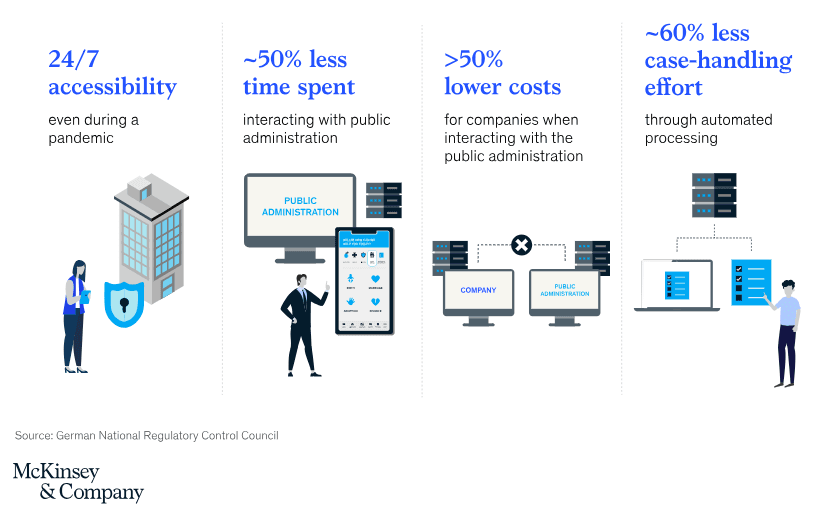
Fig: Potential of Digital Public Services. Learn more
However, despite these advancements and potential, many digital services remain inaccessible to users with disabilities. Approximately 2.2% of Nepal's population has some form of disability, including blindness, low vision, deafness, and cognitive disabilities. Additionally, digital literacy is low, particularly in rural areas. Many government digital services do not consider accessibility, creating significant barriers for people with disabilities and those with limited digital skills. The lack of unified guidelines for accessibility in government services further exacerbates this issue, as cost often takes precedence over quality.
To address these challenges, it is crucial to establish comprehensive guidelines for accessibility. A government design system could provide these guidelines, ensuring that all government digital services are accessible and user-friendly. By prioritizing inclusive design, the Government of Nepal can ensure that the Digital Nepal initiative benefits all citizens, including those with disabilities, and paves the way for a truly inclusive digital transformation.
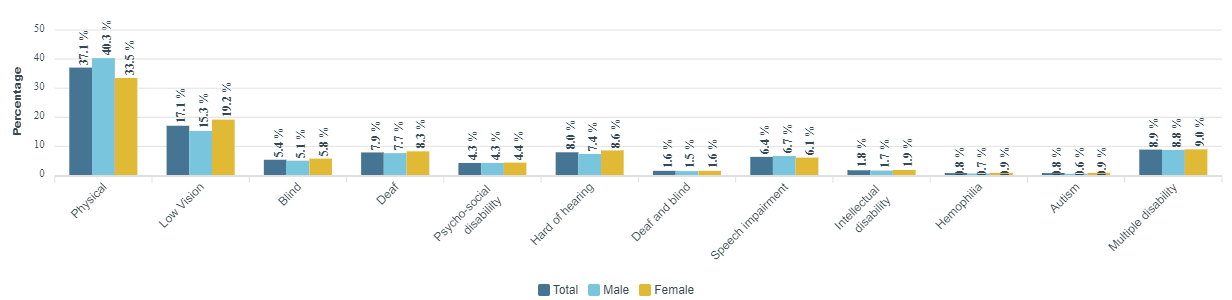
Fig: Population with disability by type. Learn more
Reliance on digital platforms in government services
There are more than 100+ government agencies and departments at both federal and state levels. Almost all of them have some kind of digital platform or services that people use to access their services or just to get the right information. Digital platforms provide a direct line of communication between citizens and the government through official websites, social media, and mobile apps.
Digital platforms also enable governments to communicate real-time updates, safety measures, and essential information to people. Digital platforms also enable citizens to actively engage in governance. Online forums, surveys, and feedback mechanisms empower citizens to participate in decision-making processes, reinforcing the democratic principles of transparency and accountability
Importance of digital accessibility in ensuring inclusivity
Nepal has always been on the back foot in terms of rules and regulations regarding these digital products, especially when it comes to people with disabilities. Due to poor accessibility, lots of people with disabilities are unable to reach and access products and services, both public and private. Technology is more needed for people with disabilities than abled ones. The essence of technology should be leveraging people who are disabled.
The capital-centric government structure poses significant challenges for citizens, requiring them to travel to the capital city for essential services. This not only consumes time and money but also creates accessibility barriers, particularly for individuals with disabilities. Shifting towards a more digital-centric approach is not only a practical solution but a necessary step for improving overall service delivery and inclusivity.
Digital Accessibility
According to the Equality Act 2010 UK (more here), disability is physical or mental impairment that has a ‘substantial’ and ‘long-term’ negative effect on your ability to do normal daily activities.
Digital accessibility is the ability to access services provided by service providers that can be either private or public through a digital platform, regardless of ability. Disability can be in different forms, such as
Sensory disability (Loss of sight, hearing, speech, etc)
Intellectual disability (difficulty in learning or understanding)
Physical disability
People with disabilities may not even be able to interact with products/services if they are not tailored for them to use. Disabled people use different types of assistive technology to interact with digital products, and products should be compatible with those technologies as well. Designing products with people with disabilities in mind from the initial phase of product development to the final stage of shipping products is digital accessibility.
According to the World Health Organization (more here), there are more than a billion people, which is around 16% of the entire population, and around 2.5% in Nepal, according to Disability Data from Nepal Census 2022 are suffering from some disability. Improving digital accessibility means improving the lives of those people.
Impact of Inaccessible Digital Interfaces
Disabled people have to depend on other people to assist them in accessing very basic services. It’s difficult for disabled people to access public services to disabled people physically, but growing digitization in public services has the potential to address issues regarding physical presence to access services.
Imagine traveling through 2-3 hr public transportation, navigating complex paths, and being in a never-ending queue just to submit a form. It sounds like a difficult task for normal people as well, but imagining being blind feels like it’s an impossible task. It can be easily done sitting at home with the help of a computer; however, due to neglecting accessibility in digital public services, it’s still a concern that disabled people cannot access technology.
Legal and ethical considerations surrounding digital accessibility
The EU has been a frontier regarding digital accessibility across digital products, from ATM to e-commerce (More in the European accessibility act). The internet and technology took off by storm in Nepal in the last decade, but there is very little talk about digital accessibility in the country, not enough to bring changes.
There have been many organizations, both government (nfdn) and NGO who work for people with disabilities, but no progress has been made, especially in terms of digital accessibility.
The Constitution of Nepal recognizes the Right to Information as one of the fundamental rights of every citizen. The parliament passed the Right to Information Act in 2007, which ensures every person’s right to access and regulate information. This ensures accessibility in various aspects of daily life for persons with disabilities. However, we have seen very negligible progress on the execution of that law at all levels.
State of Government Digital Services
Existing government websites and digital applications
Many government bodies are providing services through digital platforms like websites and applications. Services such as bill payments, appointments, applications for driving licenses, passports, Banking, and more that need to be in a long queue, taking lots of time, can easily be done now with just a few clicks on the computer screen.
Well, can disabled people also do it?
“A few years back, I was trying to get my driving license and had to fill out an online registration form at the Department of Transport Management (Link) website. During the filling process for the first time, I found navigating through different pages so difficult, and on a few pages, the text was so small that I had to zoom my viewport to make it readable.”
It doesn't even meet the basic accessibility guidelines of WCAG. Considering myself a tech-savvy person, I found it very difficult to use that service. I wonder what other people feel about it, especially if they have some kind of disability.
Good thing the government is providing services through digital platforms, but does it follow the accessibility guidelines so that it’s inclusive to all kinds of people?
Common accessibility challenges
There are lots of problems with government websites in terms of accessibility from a point of view
Most websites are not responsive. Nepal has more mobile users than laptop/desktop and websites are not designed and developed to be mobile-friendly.
Most of it doesn't pass the A11y and WCAG guidelines so even users who use assistive technology cannot consume their content properly.
I will be doing a complete case study on this issue. Follow for more.
Government Design Systems
There are so many independent websites that different government departments own. All the websites are designed and developed by different companies through contract processing. It goes down to not just federal but also state and local government.
Some companies may consider accessibility, and some may not, and it turns out that lots of companies tend to ignore accessibility. It will take more time, which means money, to implement accessibility, so they completely ignore it. I don’t blame all of these companies, but we, as a service provider, also have to consider inclusivity while developing products, even if there is no one to force us.
To address these issues, there must be a well-defined system and guidelines from the federal government to push it through all levels. A system that includes all aspects of web and app design and development that follows all the accessibility guidelines.
Design systems for standardization
That brings us to a government design system for all the government authorities that provide services digitally to follow while building a digital platform for people. Imagine a government owning its design system with proper guidelines to follow by all governing bodies that encompass the basic accessibility needed to operate for people with disabilities.
These not only make the product inclusive but also reduce the development time and cost, as they will provide basic components, design guidelines, and a foundation to build any digital services. Building design systems will also foster standardization among government digital services, which will make people familiar with services to use easily across the board, not only people with disabilities but all people in general.
Advantages of Government Design System
Building a design system is not only about creating patterns, type styles, libraries, and components but also making each element accessible by meeting A11y and WCAG accessibility guidelines.
Having a design system to adopt across public services will be a significant help.
Well-defined elements such as colors, patterns, type styles, icons, and components are pre-built with proper documentation, and reusing them instead of building one for each agency drastically reduces development time and cost.
It will help to streamline the design process and empower all levels to meet and exceed the accessibility standard.
Using reusable components also reduces development and maintenance time, which will increase efficiency as well.
With accessible design, all kinds of people can access services.
Consistency and familiarity across multiple government systems will improve overall user experience.
Challenges in Implementing Design Systems
Resistance to change
Implementing a very new system, especially in government, is extremely difficult. It has to go through multiple levels of approval and acceptance from all levels.
There are challenges in implementing across all levels of the agency, so to overcome this problem
Perform pilot tests on a few government services, and then, if it’s effective, it can convince others to follow suit.
Different authorities can also be involved in the research and development phase. This kind of collaboration from the initial phase to the overall development process can make them familiar with the design system and its importance; it will later foster a design system in new and existing systems.
Participation of people with disabilities. Involving people with disabilities in the process allows for genuine insights into their experiences and helps create solutions that are truly inclusive and responsive to their requirements.
Scalability and flexibility
A design system should be built with consistency, scalability, and maintainability as core. Following a robust system to develop a system can affect flexibility in designing for diverse needs in government service. Ensuring flexibility while building a design system can accommodate its diverse requirements.
Digital Accessibility Skills
A major challenge in the field of digital accessibility, particularly in developing countries, is the lack of education and awareness, resulting in a shortage of skilled professionals. Research on the current challenges faced by various stakeholder groups in increasing digital accessibility in EU countries (More here) says that addressing this gap requires more than just policies and legal actions—it demands skills training initiatives.
These efforts should extend beyond IT professionals to include non-IT professionals and individuals, fostering broader inclusion. Developing comprehensive training programs, certification standards, and streamlined recognition systems for digital accessibility qualifications is essential to enhance overall digital competency and inclusion.
Successful Implementations
Countries like the United States, UK, Argentina, UAE, and Australia have their own design systems to provide a unified set of design guidelines, components, blocks, and resources that enhance usability, accessibility, and user experience across all government services.
One of the early adopters of the US Web Design System is NASA. In other countries as well, many government agencies are either following it while building new services or adopting currently building services or new services.
Future Prospects and Recommendations
Nepal, as a country, has a diverse community with diverse languages. To make government services more accessible to the people in every corner of the country, from educated to uneducated citizens, Building design systems can work with multiple languages to accommodate the diverse needs of people.
AI will be the frontier technology in the coming decade and will shape the future of technology and mankind. AI can be used to leverage current challenges people with disability in day to day while working, communicating, etc.
Adaptation to this new technology has to come with new and reformed policies not only for the government but also for the private sector, where people get most of their day-to-day services.
When implementing such a system, the government can also adopt from the already successful or use open-source resources available on the internet.
Advancements in the Large Language Model (LLM) and the recent release of ChatGPT 4o with advanced capabilities in large image processing and real-time computation have shown the potential use of this technology. Bemyeyes has collaborated with OpenAI to show how this kind of powerful technology can be helpful to people with disabilities in their day-to-day activities. Emerging technology will have a huge impact on the lives of people.
Conclusion
Government-owned Design Systems could be a stepping stone to solving the digital accessibility problem, but it’s not a permanent solution. There are lots of private services that people use daily; people face similar kinds of issues with those services.
Private service providers sometimes neglect accessibility; this often leads people with disabilities to face problems accessing those services. Sometimes it can be fatal and life-threatening in terms of emergencies, mostly in the healthcare sector.
To encompass all digital services, whether public or private, the government should bring some reformed policies and make sure all kinds and levels of service address the issue related to disabled people accessing basic services. It's the government's responsibility to ensure that all people have equal rights to information.
References
Wojcik-Augustyniak, Marzena & Szajczyk, Marek & Cielemęcki, Mariusz & Stanisław, Szarek. (2024). MOVING TOWARDS BETTER DIGITAL ACCESSIBILITY - CURRENT STATUS AND CHALLENGES. 10.29119/1641-3466.2024.198.37.