
As someone who has spent the past few years building digital systems from ed-tech platforms to construction project management tools, I’ve constantly seen how deeply data influences decision-making. Now, as a student exploring the theoretical side of digital transformation, I’m starting to connect my practical experiences with the academic concepts.
This post is part of my coursework, but also something I wanted to reflect on personally because many of these ideas are shaping the world I work in and the world I’m preparing to contribute to.
Datafied Society
A datafied society is essentially the world we live in today, a world where almost everything we do leaves a digital trace. From apps that we use in our day-to-day life, from social media and online classes to workplace tools, our behaviors generate massive amounts of both structured and unstructured data.
Coming from a tech background, especially designing the systems that collect day-to-day field data for construction projects, I’ve seen how this huge amount of data drives organizations to rethink how they operate. Companies can no longer rely on outdated processes; they need digital transformation and data-driven decision-making at their core.
Data-Driven Decision Making
Data-driven decision making is a systematic collection, analysis, examination, and interpretation of data to inform practice to make change. It is the practice of basing decisions on the analysis of data rather than purely on intuition or gut feeling.
Performance improvement
Organizations that rely on data analysis are likely to be more successful and productive than those that rely primarily on gut feeling. A study by Penn’s Wharton School shows that data-driven decision making increases 4–6% in productivity, and it is correlated with higher return on assets, return on equity, asset utilization, and market value.
Process
A typical data-driven decision-making process involves identifying a problem or opportunity, identifying sources of relevant data, cleaning and analyzing the data, creating a compelling story, often through data visualization, and implementing the solution or decision.
Organizational scope
Data-driven decision making crosses all levels of the organization and can apply to all types of decisions: operational, tactical, and strategic.
Knowledge vs. Data
A core assumption in data-driven decision making is that data does not equal knowledge. Knowledge is defined as a combination of experience, values, contextual information, and expert insight, which originates and is applied in the minds of knowers. Advanced Knowledge Management (KM) systems are needed to accommodate both data analytics and human insight to support data-driven decision-making.
Change Management
Change management is defined as a systematic process approach. It’s an application of knowledge, tools, resources, and techniques to deal with change in any organization. Change management involves defining and adopting organizational strategies, structures, procedures, and technologies to handle changes in the external business environment. Change management is considered an enabler for establishing a data-driven organization.
Types of Change (Armstrong)
Strategic
Operational
Transformational.
Types of Change (Ackerman)
Developmental (incremental)
Transitional (radical shift to a known desired state)
Transformational (radical shift requiring a change in assumptions).
Process
The change process starts with recognizing the need for change, analyzing the situation, identifying and evaluating possible courses of action, and managing the transition state.
Models
Kotter’s 8 Step Change Model
Lewin’s Change Management Model
McKinsey 7-S Framework
Digital Transformation
Digital transformation is a concept that refers to the process of integrating digital technology into a business. It aims to fundamentally change business performance by rethinking how an organization uses technology, people, and processes. Digital transformation is becoming a trend in both industry and the public sector.
Focus: Digital transformation focuses on a process, a strategy, a new business model, or a paradigm shift. It is about using data from applications and processes, treating it as a high-value asset.
Shift: Digital transformation is both an organizational and cultural shift. It requires changes to strategy, business models, processes, organizational structures, and culture.
Impact: Digital transformation impacts the entire customer experience, business processes, and change of business models.
Factors: Digital transformation is a core factor for success. It includes aligning strategy, adopting user-centered design, promoting agility in delivery, integrating software, using data/analytics/insights, and maintaining a product design mindset. Success requires a clear vision, strategy, leadership, and engagement at scale.
Data Analytics
Data analytics is the process of exploring and analysing large datasets to make predictions and assist data-driven decision-making. It involves collecting, inspecting, cleaning, transforming, modeling, integrating, processing, and evaluating data to discover useful information.
Descriptive: Focuses on what has occurred. It summarizes past data, often using dashboards and KPI tracking, to help us learn from the past and overview the current situation.
Diagnostic: Focuses on discovering why it happened. It involves finding the cause based on insights from descriptive analytics, often referred to as root cause analysis, and identifies behavior patterns.
Predictive: Focuses on what will occur or what is likely to happen. It uses historical data combined with statistical modeling and machine learning (e.g., classification, clustering, time series models) to forecast future outcomes and identify risks or opportunities.
Prescriptive: Focuses on what should occur or what line of action to take. It combines insights from all other forms of analytics to determine the proper solution or outcome among various choices.
Concept Map Key Concepts and Relationships
A concept map is a visualization used for knowledge modeling, structuring concepts within nodes and defining relationships via connecting lines [Assignment Text]. The following outlines the central and important concepts and their relationships, derived directly from the source materials, suitable for constructing a concept map.
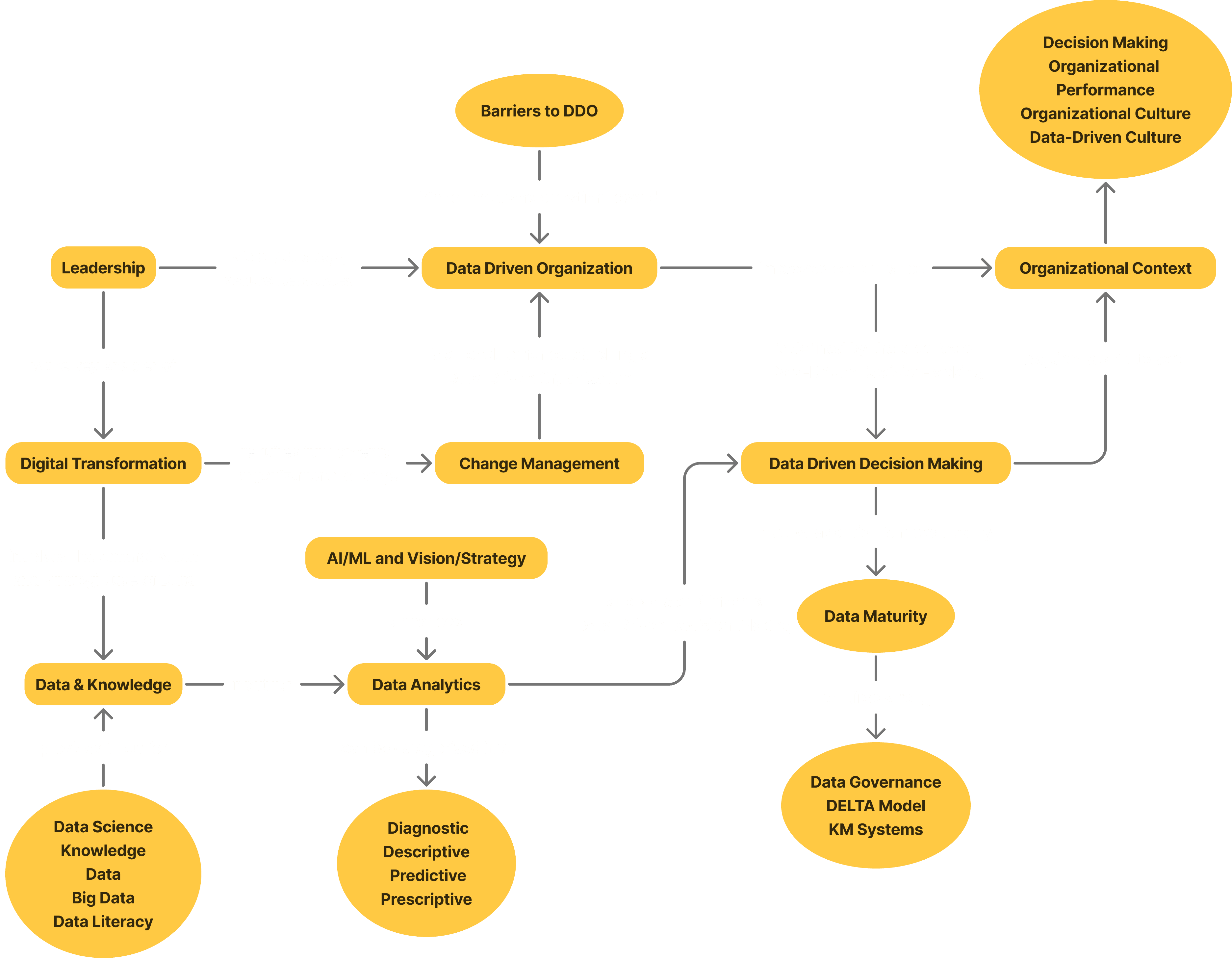
Visualization
If the organization’s transformation were a journey across a river, Digital transformation would be the destination. Change management would be the process of building the bridge, involving careful planning and tools to overcome resistance. Data-driven decision-making is the compass guiding the bridge construction, ensuring decisions about materials and routes are based on facts rather than guesswork. Data analytics are the surveying tools where descriptive tells you where you are and prescriptive tells you the best path forward. Finally, Leadership is the chief engineer, responsible for casting the vision, securing the funding, and ensuring the whole team believes in and commits to the build. The data maturity models measure how far the bridge is built and how structurally sound it is.